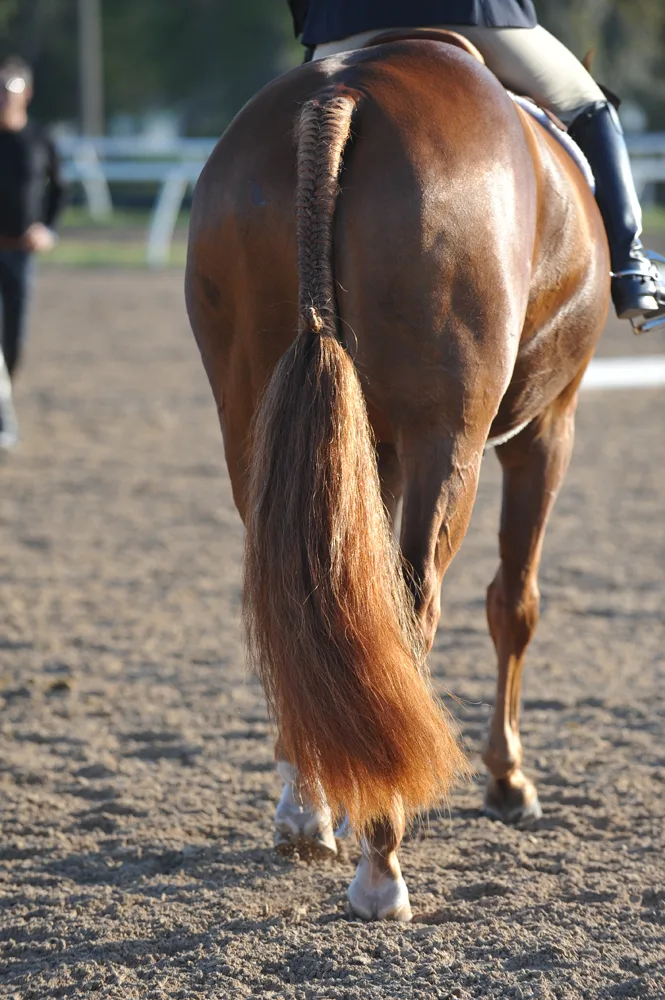
Got a wispy, fine tail you want to be luxurious and flowing? Unsure about how to pull or cut the top of your horse’s tail for that nice, trim look?
Liv Gude of Pro Equine Grooms has the answers!
No Magic Potion
“My draft-cross has a thin tail. There is nice growth at the top, working its way down. Slowly. I would really like to try to continue and encourage growth. I do not brush the tail, but I pick it gently. I tried bagging it, but he got it undone, multiple times. Are there any products to use at the dock area? I have heard mineral oil, but, what would an expert suggest?”
Tails, manes and overall hair quality are a result of good nutrition, overall health, good grooming practices, genetics, and environment. There is no magic potion in a bottle that can make tails grow. In fact, many things that are petroleum-based (like mineral oil) inhibit oxygen from interacting with the skin and therefore can inhibit hair growth.
That being said, many magic potions in a bottle CAN help you keep the tail hairs that your horse already has. A common tail enemy is tangles and snags, and detanglers and conditioners can keep the tail hair snag-free, thus preventing breakage and tearing. Many tail products also create a great shine, which we all love. Tail bags are great at keeping snags and tears out of tails, but I suggest you undo them every day to inspect the tail. They should never be secured over the tail bone, and if your horse manages to undo them, it’s likely that he will do more damage with a tail bag than without.
You will also need to decide if you are in the “manage every day” or “never touch it” camp of tail maintenance. If your horse’s tail is typically clean every single day, you can try the picking by hand method when needed. If your horse lives outside and thinks mud is his BFF, you will likely need to do daily tail care to avoid major disasters. In this case, a great detangler will be your greatest help.
Feeding your horse a high quality and balanced diet is key to successful tail growth. You must have the right nutrients in the proper amounts for things to happen. Also know that too much of a good thing is not always a better thing, as too much selenium can lead to hair loss. Create a properly balanced diet with the help of your veterinarian or equine nutritionist and consider the following nutrients: omega fatty acids, copper, zinc, iodine, lysine, methionine, biotin. These are all supportive of a healthy mane, tail, and coat in the correct balance. Also know that there are many factors that go into the creation of a complete diet, such as hay type and quality, soil conditions, access to pasture, exercise level, metabolic issues, and overall health, just to name a few.
From a grooming angle, you can bang the bottom of the tail with scissors to create one straight line across the bottom. This makes the tail appear fuller, and in most cases you only need to remove a 1/2 inch or so of tail hair to make a drastic difference. Before you do this, study how your horse holds his tail while he’s moving freely and under saddle. Many horses hold their tails out a bit, or a lot. When you bang the tail, mimic this tail position by putting a crop or polo wrap under the tail bone before you bang with scissors. When he’s moving, this will create a tail bottom that is parallel to the ground.
Good luck!
ADVERTISEMENT
Less Is More
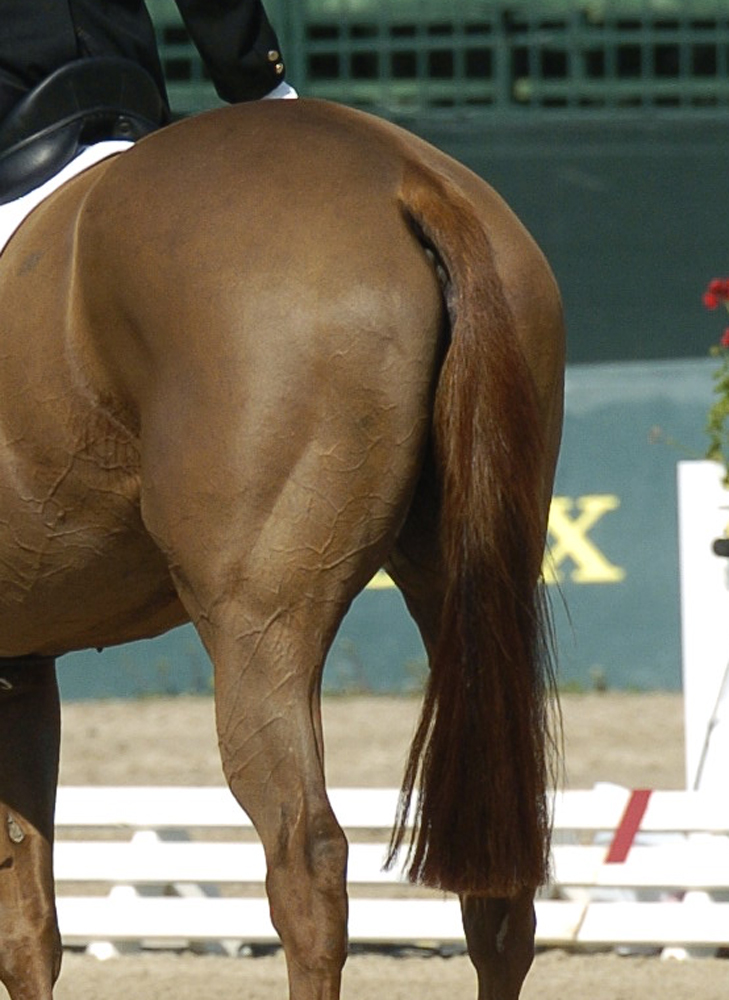 |
| Trimming the top of the tail can help flatter the muscles of the hindquarters. Photo by Molly Sorge |
“I need clear, step-by-step instructions on how to trim the top of the tail for dressage and eventing—both by pulling it and trimming it with scissors.”
Trimming the top of a horse’s tail creates a polished look, and also enhances the shape of their hind end. It’s a standard grooming practice in most dressage and eventing barns, and can be done with scissors, clippers (for the well practiced tail trimmer) and even by pulling, as you would pull a mane. Here are some step-by-step guidelines for you:
-Have a friend help you. This is to make sure your horse will tolerate you working back there, because you will be in the strike zone for kicks. Stand as close as possible to your horse just in case.
-Go slowly and remove less than you think; you can always remove more hair, but you can’t put it back! In terms of surface area, you will remove the hairs on the side of the tail from the top of the tail bone to just below the most prominent point of the hindquarter. You will only need to remove the hairs so that the “naked” part is about 1/2 to 1 inch wide, and the trimmed area should narrow the further you go down the tail bone. It should create a crescent shape.
Pulling the tail will give you more accurate results, as you are only removing a few hairs at a time. The result is also cleaner. I’ll start with instructions for pulling.
-Wear latex or rubber gloves so that you can grasp the hairs easily.
-Have a friend help you handle your horse, the pulling can be surprising until your horse gets used to it!
-Work from the top down, creating one trimmed row at a time. Start with the hairs that are closest to the underside of the tail, so that as you complete rows of nakedness, your can see the final result come to light.
-Grap a few hairs at a time, and give a yank. Too hard to pull out? Try fewer hairs.
ADVERTISEMENT
-When you think you are halfway done, step back and take a look. You may be all the way done. It’s fine to stretch this process out over a few days, to minimize the horse’s discomfort.
For a super-quick scissor method, give this a go:
-Let your horse’s tail be natural—and by this I mean don’t try and brush it into a shape before you start with your scissors.
-Hold your scissors perfectly vertically and rest your scissor-holding hand against his bum just to the side of his tail.
-Move your vertical scissors over to his tail and clip off a few millimeters of what pokes out. You won’t notice much of a difference yet. Go from the top of the dock to just below the most prominent part of the hindquarter.
-Move your vertical scissors over a few more millimeters and snip off a few more millimeters. Work this way until you are happy with how it looks.
-Take a step back and look, too. The overall thickness of his tail and his bum will guide you as to how lean to make the tail dock appear.
-The goal is to have vertical edges on the side of the tail, which is why keeping your scissors vertical is critical.
Do you have any grooming questions or mysteries you’d like answered? Email them to us and Liv will address them next month!