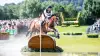
Across the nation, equestrian programs built around everything from rodeos to rehoming Thoroughbreds to training wild mustangs are helping rehabilitate the incarcerated.
When Tamio Holmes was sentenced to prison on drug dealing charges in 2003, he hit rock bottom. He’d already spent more than two years behind bars starting in 1998, and now he was facing another eight.
“I felt like, ‘Screw you,’ ” Holmes says of the day the judge sentenced him.
That moment of raw anger peppered with indifference eventually turned to numbness as prison life became his everyday reality. Days slipped into months, and more than five years passed. But finally Holmes got a break that would ultimately reverse the negative trajectory of his life.
It came, poetically enough, because of others who also needed a hand: Thoroughbred horses. Holmes would find his rehabilitation—and eventually a career as a farrier—in helping to prepare the horses for new lives. The long days of feeding, grooming, exercising the horses and taking classes on their care gave Holmes a renewed sense of purpose.
“It was exhausting, but I couldn’t wait to get up the next morning every day and get back out,” Holmes says. “I was helping them, and they were helping me feel better about myself.”
Holmes is one of 50 inmates to graduate since the Second Chances program at the James River Correctional Center near Richmond, Va., was created in 2007. Run in cooperation with the Thoroughbred Retirement Foundation, the program saves former race horses from possible abuse and slaughter. It’s just one of several inmate-horse rehabilitation programs run by the foundation and other entities around the nation.
Anne Tucker, board president of the foundation’s James River chapter, observes the transformation of Holmes and many other inmates. She says the bonds between the inmates and the horses create a sense of self-worth.
“The inmates come in and work with the horses and start to think, ‘I’m not all bad. Maybe I’m not totally useless,’ ” Tucker says, adding that the offenders—inmates who committed only non-violent crimes—learn not just job skills, but a sense of community.
As for the horses, they vary. Some are young and fresh off the track; others are in their 20s. In five years, James River has placed 26 of them. A few horses have the potential to compete again in second careers, while the reality for others is simply a lifetime of pasture ornamentation. Whatever their abilities, Tucker says, James River has a place for all horses to be loved.
For Holmes, the program brought back good memories of his boyhood in rural Louisiana.
“We had horses when I was a kid,” he says. “So horses were always kind of like a friend to me. More than that—like a partner.”
Holmes says deep down in his heart, he was a good kid, raised by a loving grandmother, though life could be tough at times.
“Everything you had, you had to work hard for,” he says. “We made do with what we had.”
When he grew up, Holmes imagined a more prosperous life for himself in the Richmond area. But when he got there, he only found low-paying labor jobs and a party lifestyle fueled by drugs.
ADVERTISEMENT
“I chose to hang out with people I shouldn’t be around,” Holmes admits. “They weren’t my true friends. I was just trying to impress people.”
Those days ended with a ride to prison, and working with the horses was a privilege Holmes earned. He tried hard to be a model inmate, steering clear of trouble. He hit a low in 2010 when his grandmother died, and he was unable to attend her funeral. But he took solace in the fact that his grandmother knew he was in the Second Chances program and was already starting to turn his life around.
“Overall, I found, I was a good person,” says Holmes, who was released from prison in early 2011. “I made some bad decisions. I can’t change that, but I would advise others that there is always hope. There are other options. I look back and think, ‘I should have struggled harder in hard times.’ Now I’m going for what’s good in life.”
And the program taught him something else as well: That there are people out there who don’t give up on former convicts. Holmes wants to repay their kindness, adding that there’s something particularly special about people who love horses.
“I’ve met some of the best people in the world doing this,” he says. “The majority of them are kind and tender-hearted. I think that’s maybe because they’ve had struggles somewhere in their lives, and they know what it means to receive a helping hand.”
Behind Bars, Trophy Buckle Dreams
There does seem to be something about the outside of a horse that is good for the inside of a man, and when this famous Winston Churchill quote is mentioned to Warden Burl Cain, who’s media savvy and charismatic in the style of the best evangelic preachers and Louisiana politicians, he nods in agreement.
Cain initiated the equestrian program at Angola Prison in southern Louisiana and looks at horses as valuable, non-judgmental teachers that help offenders learn two important things: The first is patience.
“The second thing they learn is that aggression is not an option,” Cain says.
A visit to the Angola Prison Rodeo or Horse Sale, which take place a two-hour drive from the vibrant heart of New Orleans, is like a good Cajun filé gumbo—there’s a lot to digest.
An open mind and open checkbook are a must for visitors at Angola’s semi-annual events. If you’re inclined, you can bring home an offender-trained sport horse with a Louisiana State Penitentiary registered brand on its hip. For collectors of prison ephemera, there’s a wide variety of prison art for sale directly from inmate artists. Or you can sample fried Coca-Cola while listening to a gospel band of “lifers” play “Knocking On Heaven’s Door.” The Angola Prison Rodeo, held every Sunday in October, is nothing if not a spectacle.
Officially called the Louisiana State Penitentiary but better known as LSP, “Alcatraz of the South” or “The Farm,” Angola is the largest maximum security prison in the nation. It was once also known as the bloodiest. But for the inmates involved in Angola’s equestrian program, it’s exciting to see the prison earning a new reputation, best known for hosting “The Wildest Show in the South.” This year marks the 47th anniversary of the longest-running prison rodeo in the country.
Angola’s rough riders are ¼ cowboy and ¾ gladiator, natural-born risk takers with nothing to lose and a trophy buckle badge of honor to win. The Farm is a place where sinners mounted on horseback can become winners again.
After the rodeo lights on autumn weekends have dimmed, however, Angola’s less raucous annual horse sale, which began in 2010 and is held the third weekend in April, showcases the prison’s own breeding program; the inmates work with Dutch Warmblood, Thoroughbred, Quarter Horse and Percheron bloodlines and train young horses as prospects for sport horses, ranch horses, trail mounts, pony horses at the racetrack or training center, pleasure and service animals.
In this year’s edition of the auction, 80 Angola horses sold, going for between $300 and $3,500. Some go to police for mounted patrol units throughout the country, a Dutch Warmblood-cross from last year’s sale has become a ribbon-winning show jumper, and this year foxhunting folks from as far away as Maryland left with Percheron-Thoroughbred crosses in tow.
ADVERTISEMENT
Israel Ducré, a longtime resident at Angola, worked with race horses in his former life on the outside. With 22½ years served under his “All Around Cowboy, Angola Prison Rodeo, 2003” belt buckle, he says training horses makes the sentence more bearable. It’s hard for him to watch the horses he’s trained be sold off to new homes—at this year’s auction he said he’ll be especially sad to see a bay wearing hip tag 703, a gelding he named Little Pen (short for Little Penitentiary), leave. But Ducré can’t imagine not being involved with the program.
While many prisons are known more as rehabilitation facilities, Angola isn’t one. The billboard just outside its security fence that reads, “You are entering the Land of New Beginnings,” is, unfortunately, not a reality for most of the facility’s inmates. In fact, over 90 percent of the men who enter will die there.
But for inmates like Ducré, working with horses gives them a reason to keep going and a means to give back to society. And for the ones who will eventually rejoin it someday, the experience will have equipped them for a whole new kind of life.
Saving Mustangs And Men
A similar story is unfolding in Colorado, where inmates take on the tough task of befriending and training American mustangs as part of the Wild Horse Inmate Program. Unlike Angola, however, Colorado’s program is comprised of minimum-security prisoners who are brought from their respective correctional facilities to Cañon City, the largest short-term mustang holding and training facility in the nation.
The program, called WHIP, began in 1985 and has grown from including a few hundred wild horses to thousands, according Brian Hardin, who oversees the program. To date, more than 5,000 mustangs have been trained through WHIP.
Known for the toughness that’s allowed them to thrive in the American West’s harsh conditions for hundreds of years, the horses run free on property administered by the Bureau of Land Management.
Through WHIP, inmates are taught to select wild horses and halter break or train them for western riding and use as trail, youth and handicapped or therapeutic program mounts. Some are used in the Wounded Warrior wellness program at the U.S. Air Force Academy Equestrian Center, just north of Colorado Springs. The project helps troops heal from the physical and mental damages of war.
“They’re good horses,” says Billy Jack Barrett, director of the USAFA Equestrian Center, adding that he’s also heartened to know a few inmates who have turned their lives around through WHIP, some of them finding careers in the horse industry. Many others are still riding.
Allen Heinze, who is serving six years in Canon City for robbery, never had prior experience with horses. Now the WHIP program at the Colorado Correctional Industries-run prison is teaching him to train horses for use by the U.S. Border Patrol. He’s learning everything there is to know about them, from anatomy to feeding to training a horse fresh off the range.
When a horse is selected for training, it has never had contact with a human before. It often takes days or weeks—even a month—before a horse will simply let a person lay a hand on it. Halter training comes next.
“We work on getting that horse to face up or square with us,” Heinze explains, adding it’s a long time before a saddle finally goes on, let alone a rider.
The process is arduous, but rewarding, Heinze adds. “It teaches profound patience.”
This article was originally published in the October 2012 edition of The Chronicle Connection. To learn more about the Connection and view a sample issue, go to chronofhorse.com/welcome-chronicle-connection.