Like you’d expect from any activity involving green horses, the 100-Day Thoroughbred Challenge offered spectators at the Maryland Horse World Expo, Jan. 18-20 in Timonium, Md., some thrills, spills and surprises. But it also offered inspiration (to ride better), information (on why Thoroughbreds off the track do some of the things they do), and a solid case made on behalf of ex-racers as excellent sport horses-in-waiting.
This is the second incarnation of the Retired Racehorse Training Project’s showcase at the Expo, building off the success of last year’s Trainer Challenge. This year’s format was different—instead of sending horses home with different trainers, all four horses in the Challenge are being trained at Steuart Pittman’s Dodon Farm in Davidsonville, Md. The change simplified the logistics of working with the horses’ owners and was easier to present in the hour-long Expo time slot. But it also moved the focus from the guest trainers to the horses and the farms that offered them to participate in the challenge.
An article about the program in the magazine Mid-Atlantic Thoroughbred just before the Expo had raised the level of interest, and Pittman said the RRTP booth had seen many visitors from the racing industry, more so than in the past. Their model of increasing the demand for Thoroughbreds off the track by promoting them to sport horse riders, rather than relying on a rescue model, “makes a lot of sense [to the racing industry], and it respects the horse,” said Pittman.
The training challenge is somewhat modeled after the 100-day testing for warmblood stallions, Pittman explained. He noted that most of the spectators in the stands at the Expo probably weren’t yet ready to tackle retraining a Thoroughbred off the track, but he hoped it would become a goal for many of them. “I want them to be inspired to learn to ride better, so that they can get the same thrill that we do on these horses,” he said. “Watching these horses inspires people to ride better, which is good in itself. It’s not just about placing more horses; it’s also about improving horsemanship.”
At the start of each of the three demo sessions, Pittman made a point of introducing the horses and filling spectators in on their stories, but he also mentioned all the horses’ connections—breeders, trainers, owners, all with Mid-Atlantic ties.
Four horses were supposed to be showcased, but as spectators who’d been following their progress via the RRTP’s website and Facebook page already knew, a mare named Gunport suffered a hock injury just a few days before the Expo and didn’t make trip to Timonium. In addition, one of the riders scheduled to participate dropped a couch on her foot and broke it, so she was unable to ride. (Best laid plans, anyone?)
The three horses who did attend were Alluring Punch (a 2009 chestnut gelding owned by Northview Stallion Station and Barbara Ryan), Suave Jazz (a 2003 dark bay gelding owned by Walnut Green Farm), and Declan’s Moon (a 2002 dark bay gelding owned by Country Life Farm and Jay Em Ess Racing). The three horses had about six weeks of training under their belts.
Getting To Know Them
The first session on Friday was an introduction—both for horses and for spectators. Pittman, who emceed all three sessions, provided lengthy biographies on the horses while they were hand-walked around the ring, acclimating to the small space and the sizable crowds. Friday’s session focused on free-jumping, but unfortunately Declan’s Moon had slipped coming off the trailer and was a bit off behind, so he didn’t get to jump.
|
ABOUT THE HORSES: Declan’s Moon (Malibu Moon—Vee Vee Star, by Norquestor) is an 11-year-old Maryland-bred gelding who won the Eclipse Award as an undefeated 2-year-old. An injury cut short his 3-year-old year and prevented him from running in the Kentucky Derby, but he ran an additional 13 times after his recovery and was then retired. Suave Jazz (Suave Prospect—Cavite Starlet, Jazzing Around) is a 10-year-old gelding who ran 70 races and won $651,000. ADVERTISEMENTGunport (not at the Expo) (Mizzen Mast—Directive, Deputy Minister) is a 4-year-old gray filly bred by Sagamore Farm. She trained to race, ran once and was dead last. |
Pittman pointed out how each horse’s movement and conformation translated to their jumping styles. Alluring Punch’s sloped croup gave him the effect of a coiled spring, and so a smooth and effortless jump. Suave Jazz, on the other hand, showed a bit of knee action in his trot and was quick and catty with his feet. Both horses free-jumped through the chute several times, relaxed and looking as if they’d done it dozens of times before.
Saturday’s session was in the main arena at the Expo and was packed with spectators. All three horses showed under saddle, working up to jumping a couple of small fences at the trot and canter.
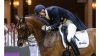
Pittman rode Declan’s Moon, who was the most obviously “up” of the three horses. “These other two, they’re almost boring, they’re so good,” he joked. “I like Declan because he scares me a little!” He explained the importance of giving a Thoroughbred the chance to move forward when nervous or anxious, and all three horses spent the first portion of the program just trotting around and settling into their work.
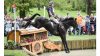
All three were also wearing yokes (like a standing martingale without a strap going to the horse’s head), just like many jockeys use at the track, to give the riders something to hold onto should any shenanigans arise. Pittman demonstrated how he kept two fingers of one hand under the neck strap as he started trotting Declan around, just in case. And in fact, Alluring Punch showed just what can happen with a young horse in a new and exciting environment—he clipped a jump standard as he was trotting by, knocking it over, spooking himself and unseating his rider. (She was fine and popped right back up into the saddle and went right back to work.) “These things happen when you’re working with horses,” Pittman said. “He doesn’t care; he’s ready for more.”
This purpose of this session was to demonstrate what the horses could do after having been in training for about six weeks. Alluring Punch, the youngest of the group and the one who raced the least, was the most obviously green. He wasn’t as focused as the other two horses, spending a lot more time watching the spectators. He was more nervous in the trot but much more settled in his canter. Horses that haven’t raced much haven’t yet developed into athletes, Pittman noted. “They’re sort of teenage gangly things,” he explained, while horses with more racing experience, while still green in their new jobs, are more able to focus and settle into work.
Alluring Punch had been pulling quite hard early in his re-training, and then he started curling up away from the bit and sucking back, an issue Pittman said was helped by taking him out trail riding. (He noted that all three horses had been ridden on the trails quite a bit, and Suave Jazz had even been out foxhunting three weeks after arriving at the farm.) As his rider worked him at the trot, Pittman pointed out that he was giving her a connection to the bit about half the time.
Suave Jazz showed he was a bit farther along in his redevelopment. “It took about one day to teach that horse to respect the aids, get a good connection in the bridle, and to move off the leg,” Pittman said. “It’s like every night he studies his lesson from the day before, and he comes out better the next time.” In his canter, he showed that he still needed support from his rider and showed a tendency to lean but was almost ready to be able to do a small course of jumps.
“Look at the way he moves, for a horse who ran 70 times,” Pittman said. “Don’t assume that a horse that has run a lot is less good. In fact, some of them are better.”
Declan’s Moon, Pittman said, “in my mind is the epitome of what the Thoroughbred industry can breed.”
“He disproves the idea that the breed isn’t designed for success in dressage,” Pittman said, as he worked to settle the bay gelding into his trot and show off his movement. “He is a great race horse. And he is a great dressage prospect.” He noted that Declan actually needs quite a lot of leg to keep him on task, contrary to the image of a Thoroughbred as always needing more “whoa” than “go.”
He described Declan as being like riding a very soft trampoline. “Look at the quality of that canter—that’s balanced. This horse is not leaning on his forehand at all.”
Dressage Is The Foundation For Everything
ADVERTISEMENT
The third and final day at the Expo included an unmounted session where Pittman spoke about how to select a horse off the track, and then an afternoon session titled “Jockey Dressage,” which Pittman explained should really have been titled “what jockeys know that the rest of us should learn.” Ex-jockey Jennifer Stisted rode Suave Jazz, demonstrating how jockeys typically mount, their position at the trot and canter, and their methods for getting their mounts to go faster (by pushing their hands on the neck in a rhythm, to get the horse to increase his stride) and slow down (by dropping their hands).
He pointed out how Alluring Punch’s rider was adding leg to help get the horse lighter and reduce the pulling. “It’s a level of training all the race horses need to go through,” Pittman said. He emphasized that horses coming off the track “carry a lot of weight in the bridle, and they lean; they lean down on their forehand to do it. If we want them to be jumpers or dressage horses, they need to learn to carry more weight in their hind end.”
By adding leg and asking the horse to compress like a spring, the rider gets the horse off of the forehand and carrying himself, Pittman explained, adding that it can be scary for a rider new to off-track Thoroughbreds to feel all that weight in the bridle.
Although the session focused on dressage, Pittman emphasized that horses right off the track aren’t ready to be ridden in anything resembling a typical dressage seat. In fact, he doesn’t even recommend using a dressage saddle at first—Declan’s Moon was wearing one for the very first time during the session—because ex-racers are used to having their rider be more up off their back.
He pointed out that as Stisted was cantering around on Suave Jazz standing up in her stirrups, the horse was essentially in a frame that would be appropriate for a training level dressage test and was balanced. “You don’t need to sit on your butt and ride with your seat to get it done,” he said.
Watch Alluring Punch go…
Watch Declan’s Moon go…
Watch Suave Jazz go…