Three top riders explain how they train their horses between shows to keep them at the apex of the sport without compromising their soundness.
A horse who competes at the grand prix level in show jumping has attained the pinnacle of achievement in the sport and, presumably, reached the top of the training scale. So how do you school a jumper at this level in between the rigorous shows in which he performs? Do these horses regularly practice over gargantuan fences at home? Do they take trail rides? Are they turned out? Here’s an overview of how Peter Wylde, Mandy Porter and Will Simpson maintain their top mounts.
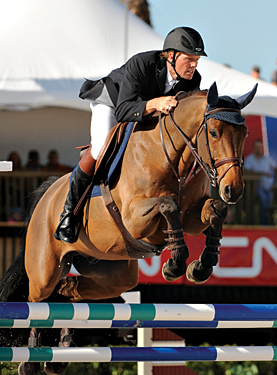
Peter Wylde
Home Base: Wellington, Fla.
Peter Wylde has, over the many years of his illustrative career, developed a training regime that virtually all of his horses follow, regardless of their competitive level.
“My show schedule is based on my goals for the year, as well as the current level of horses I have in training,” said Wylde. “This year, my calendar revolves around qualifying and, hopefully, competing in the FEI World Cup Finals and our Olympic selection trials and, hopefully, the Olympics. That means this year I’ll be in Florida from January until the end of March and then I’ll return to Europe where I’ll spend the rest of the year.
“Each year I attend approximately 35 international shows, in addition to a handful of national shows. It’s a very busy schedule for me, but in Europe you can take only three or four horses to any given show, which means that each horse in my stable competes at between 10 and 18 shows a year, depending on the horse,” he explained.
All of Wylde’s horses are exercised twice a day, six days per week. Every horse is ridden on the flat for approximately 30 minutes, which includes 10 minutes of walking before and 20 minutes of diligent schooling. This routine happens every day, either in the morning or the afternoon.
“Most days I like to have someone take the horse for a 20-minute walk in the woods after I’ve ridden them on the flat,” Wylde added.
If a horse is ridden in the morning, then that horse will do a second activity in the afternoon. Or if the horse is ridden in the afternoon, then it will always do something first in the morning.
Depending on the horse, the second activity (in addition to being ridden) is one of three different choices. Either the horse will go on the walker for an hour, go in the woods at a walk or sometimes trot for 40 minutes, or he’s longed for 30 minutes. The longeing consists of walking by hand for five minutes then at the trot for five minutes left, five minutes right then left then right, followed by another five minutes of walk by hand. The second daily activity for the horse depends on the specific horse’s fitness and training needs.
“Despite the fact that we have beautiful paddocks at our stable, I only allow some of my horses to turn out,” Wylde said. “I think turnout is a great thing in a safe environment, but some of my horses are a little too wild for me to feel comfortable letting them loose. They’re just too valuable, and I’m just afraid of injury.”
Those that don’t get turned out are hand-grazed for 20 to 30 minutes a day. On the horse’s day off, one day per week, each horse is hand-walked twice.
In general, Wylde jumps each horse twice per week but rarely jumps more than 4′ at home.
“I would only school over larger fences if the horse had a specific problem that I needed to work on, like a combination issue, or if I had a rideability issue that I needed to improve,” he explained. “Occasionally, I would jump a greener horse over a few fences slightly higher than normal, just to make the horse feel more comfortable with the height at an upcoming show.”
The first school in a given week normally consists of small fences or caveletti. “I like to jump caveletti a lot, maybe three to five in a row or even just two in a line of four or five strides,” said Wylde. “I find by jumping small fences, you can accomplish a lot of things. It’s good for their ligaments, tendons and muscles while not putting too much stress on the joints. You can also work out a lot of rideability issues by doing different numbers of strides down the same line.”
“Also five caveletti in a row [10 feet apart] quickens their jump from the ground,” he continued. “For the second school of the week I might set an oxer-to-vertical combination on a shortish distance, like 33′ or 34′ for two strides, or a vertical to an oxer in one stride. I’ll usually set these combinations low and then build up to the horse’s respective height. Then I might have a simple line of five strides, again oxer to vertical, which I will also start low and then build up. On a single vertical, I sometimes like to use a placing rail, set 9′ before the jump, which I’ll start at 3′ and raise to about 4’3″.”
ADVERTISEMENT
As a general rule, Wylde doesn’t jump his grand prix horses the week after a show. If he has a rare five- or six-week break between shows, he might give a grand prix horse two weeks of flatwork before he would start jumping again, two times per week, up to the show.
“I think it’s a huge mistake not to jump a horse for three weeks and then go to a big show,” Wylde said. “You have to stretch the horse’s suspensories and ligaments over fences, even if it’s just small caveletti. You can’t do this just on the flat. You would never see a human athlete not training for weeks and then showing up at a competition. Horses are athletes, and we as riders need to make sure their bodies are in good form!”
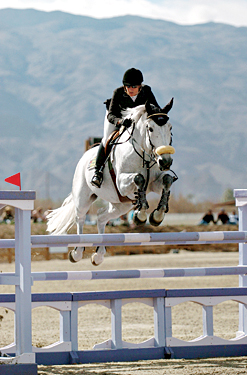
Mandy Porter
Grand prix horses: Summer, 11, Belgian Warmblood mare owned by Wild Turkey Farm; Enfuego, 10, ISR mare owned by Mandy Porter and ACP Enterprises, Inc.; and Stairway, 9, Dutch Warmblood gelding owned by Wild Turkey Farm.
Mandy Porter’s training schedule varies from horse to horse, and she believes in building diversity into her training schedule.
She competes at roughly two shows a month and gives her horses time off–with light riding but no jumping—from mid-November to mid-December. She rides her horses once a day at home, and they almost all are turned out daily.
“My primary focus at home is fitness,” Porter said.
She believes strongly in hill work, and she trots—and sometimes canters—for about 45 minutes, up and down the hills close to her farm. “I just want to feel the horse pushing from behind and really working on the hills,” she said. “From where I’m based now I can hack to hills, but I’m not adverse to putting horses into the trailer and finding the terrain I need to build fitness.”
She alternates between days of hill work and flatwork sessions in the ring, working the horses to build a strong topline and stretch their entire body with slow, collected work.
Her jumping schedule at home depends entirely on her horse’s performance at the most recent show. “If a grand prix horse is going well I won’t do gymnastics at home,” she said. Instead, Porter incorporates small, three-foot jumps into her flatwork.
“I’m looking for the jump to become just another canter stride, with no major change in rhythm, so the horse just steps softly over the little fence.
“My grand prix horse already knows her job,” said Porter of Summer. “My main emphasis between shows is to keep her mentally fresh. I don’t ever want her to feel like she’s doing the same old thing, day after day.”
Porter doesn’t specify a number of jumping days per week; instead, each horse jumps according to Porter’s assessment of what the horse needs on any given week.
She generally doesn’t jump higher than 4’3″ at home, and she tailors her gymnastic exercises to suit the needs of a particular horse. “I might set up a line and work on adding or leaving out a stride to practice adjustability. Sometimes I’ll set a course, sometimes I’ll work on individual jumps. If a horse seems weaker on one lead than the other, I’ll set a series of small bounces on a circle. I also like to set lines of bounces interspersed with verticals and oxers. The jumps don’t have to be high, you just want to make the horses think about using all parts of their bodies and being quick with their feet,” she explained.
“Regardless of a horse’s experience level, a gymnastic should always build confidence, especially in a young horse,” noted Porter. “You can build a gymnastic to work on a horse’s style–use V-rails to help improve their technique, for example–but you never want to build anything too tricky or trappy.”
When a major show approaches, Porter raises the jumps closer to grand prix height and gives even her seasoned horses a school. “You have to raise their eye level and get them thinking more about the bigger jumps before they head back into the ring,” she explained.
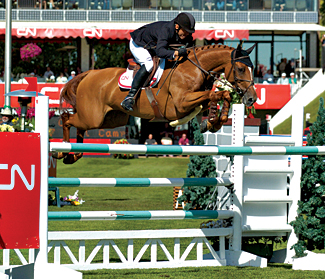
Will Simpson
Grand prix horses: Carlsson Vom Dach, 12, Holsteiner gelding; El Campeon’s Tosca, 12, Belgian Warmblood mare. Both horses owned by El Campeon Farms.
ADVERTISEMENT
The 130-acre venue at El Campeon Farm in which Will Simpson trains allows him to focus on cross-training for his grand prix jumpers.
“A grand prix horse already knows his job,” said Simpson. “So I focus on keeping his mind fresh between shows. I try to do as little ring work as possible and ride out in the hills, or in our grass fields, instead.”
Although Simpson said no training schedule is set in stone for any horse, he believes in keeping his horses fit and working all year, with the exception of a brief letdown in December. His horses always get turned out each morning, plus they spend about 30 minutes on the walker each day. If he has additional fitness concerns, he’ll work his horses on a treadmill.
“The treadmill also helps to lengthen out their stride because of the evenness of the footing,” he maintained.
Simpson’s grand prix horses always enjoy a day off after a show, followed by an hour-long trail ride the next day. Simpson does as much hill work as possible, several days per week, but mostly at the walk due to the trail’s rocky footing.
Like other grand prix riders, he often doesn’t choose his show schedule. “The selection trials schedule pretty much tells you where you have to go,” he said. But Simpson finds he usually spends two months showing with three weeks to a month in between.
He rarely jumps his grand prix horses at home. “In fact, I’m looking around the farm right now, and I don’t see a jump set up anywhere,” he quipped.
Instead, he focuses on flatwork at home. “It’s all about preparing the horse on the flat for jumping,” he said. “Working on two-tracks, shoulder in, you’re building the horse’s body, isolating certain muscle areas and strengthening them with flatwork exercises, so they’ll have strong backs and be fit and ready to jump.”
When Simpson does jump at home, he tries to pinpoint whatever competitive weakness his horses might have, then sets exercises to target those areas at home, generally jumping between 3’9″ and 4′.
His favorite gymnastic involves five wide oxers with short distances in between each. “I want the horses to be quick and accurate with their footwork between jumps but really use their backs in the air,” he explained. “I won’t raise the gymnastic much past 3’9, but I will keep widening the oxers.”
He believes in cantering into the gymnastic, so both horse and rider can work on their eye. “Trotting into a gymnastic over trotting poles is just too far removed from what we have to do in the show ring, so I don’t see much point in practicing this way,” he noted.
After a horse has received a break from jumping–after a big show, perhaps–Simpson likes to start them up again over bank jumps. “The bank is really the truest jump, since the horse has to stay balanced and catch his weight on top of the bank as he lands,” Simpson said. “Those jumps don’t move, and a horse has to stay 100 percent concentrated on his job.”
As the show approaches, he’ll begin jumping more often. He’ll add another gymnastic to the program, four verticals set on short (21-foot) distances, with placing rails or caveletti in between each.
As a final school, he’ll add pace and practice open distances to oxers, or even set up a practice course for himself at home.
“You can’t go to a big show off of just gymnastics,” he said. “You and your horse have got to be sharp.
“Let’s face it, all the riders at this level know how to jump verticals and oxers,” Simpson explained. “It’s doing something a little different, custom-tailoring each school for each horse, that will give me an edge. When to do what? That’s what we’re all searching for, how to prepare for the show and be ready when we get there.”
Annie Eldridge