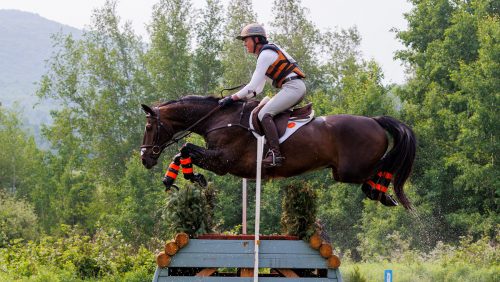
Situated in the middle of horse country, Plantation Field has steadily grown from a local horse trials into a destination event. This past weekend riders flocked to Unionville, Pa., from up and down the East Coast to participate in the CIC and horse trials. Joanie Morris had the chance to sit down with organizer Denis Glaccum and landowner Katie Walker to discuss the evolution of the event, what it means to the community, and what it can do for the sport of eventing.
How did you end up having this event here on this wonderful piece of land?
Denis: I approached the Walkers in 2000 and suggested that this field, which until then had been primarily used for grazing cattle, would be a superb place to run a horse trial. I always wanted to go back and do an international event, but that wasn’t the first thing in my mind then. The biggest change now is that we have the property behind the original piece of land, we have access from four roads, and we don’t have to use the ground across the street. That has created a whole new dynamic.
Cuyler Walker, whose family has owned this land for years and years, had no eventing background, but now they are not only enthusiastic about our event, they are also enthusiastic about the sport and making this a go.
Now we have the community, led by Katie and some other wonderful people who manage the “non-equestrian” side of it, and we all get along relatively well with each other. I don’t work well on a committee; I like the old Frank Welling phrase that a committee of three is two too many. So we don’t really call it a committee. We call it a small group.
Did this evolve past your expectations?
Denis: Yes. There were limitations on the property. Most of them now can be addressed through growth. It’s a much better venue than I thought because of the natural old turf and the type of soil. I haven’t seen any place in this country where the loamy topsoil is as plentiful.
When you started to get involved in this event beyond as the landowner, what was your vision for the event and your involvement in it?
Katie: Denis had been a tenant for years, and we had attended the event as spectators, but when Denis started the international levels, I think we did it for one year, and then Phillip Dutton sat us all down and said, “I think this could be something.”
That piqued my interest as well that of a few others. We met a few times, came up with some ideas and threw it together. We are now in our fifth year, and year by year it’s just gotten way beyond any of our expectations and fulfilled what Phillip had talked about in that first meeting.
We wanted to make it a community-oriented event. We had two goals: to get people out here to see the majestic beauty of this open space and to expose people to this wonderful sport of eventing. We definitely achieved the first one, and the second is a work in progress.
When I first sent out sponsor mailings, the money just started coming in; people were behind it from the start. There were hiccups and bumps, but everyone stood by it. There is a lot of loyalty there. It has been far, far beyond what we had hoped.
Denis: You can run a horse trial and survive, but you cannot run a CIC without sponsorship. Katie and her crew got involved and have done an amazing job.
Talk about the arena.
Denis: Mary Alice Malone of Iron Springs Farm and Joy Slater gave us the Tapeta footing. I designed the arena to be as natural as possible, and that’s why it’s an oval because that was what the property is: an oval. I’m not an architect, but Frank Lloyd Wright was, and he believed in natural architecture, and that is how the arena fits. And then we got someone to build it, and I designed it. What was fun is that each step of the way Katie and Cuyler would come up with ideas, and we would improve upon the initial design.
For example, when we had it pretty much done it was apparent that we were going to have a dirt bank. We thought, “Wouldn’t that be great if it were a stone wall?” Immediately, Katie and Amy Ruth Borun jumped on the idea and found the funds to do it and found the people to sponsor it.
Katie: And Amy was one of them. I got all the stone donated, and she funded the construction.
ADVERTISEMENT
Denis: We need more footing and more arenas and a lot of other things. But they will come as long as the eventing community wants to support this. American horses, even when they go to Rolex Kentucky, are at a disadvantage to the rest of the world as they aren’t in venues where there is atmosphere and an electric environment. One of our biggest objectives, by keeping it just at the upper levels, is to give them experience competing in a high profile and highly electric atmosphere, and that is what we are trying to create.
Tell us a little bit about the work that has gone into the course.
Denis: When we came in off the old road, the course was a serpentine coming up the hill. As soon as we changed the orientation of the venue to the top of the hill, the whole direction of the course changed, and the serpentines are across the property.
It was a challenge. But we got together with Tremaine Cooper, who designs the CIC*** and the committee, and we said, “Look let’s have a strategic plan even if it’s a loose one—let’s have a plan where we can come up with a track.”
The gallops are dedicated lanes and are mowed, and we have a wonderful person on our committee, Jamie Hicks, who is from a third generation farm family, and he advises us. We put mushroom soil down this summer, which improved the nutrients and the footing.
So what’s next? You had a huge crowd here over the weekend. What’s the next step to keep growing it?
Denis: Well physically, we know we need to improve the electricity, the water and the arenas, and we need better access. We will continue to make changes on the cross-country. What was really great yesterday was that you saw thousands of kids here, and that is what we want.
Katie: The atmosphere we’ve created here is basically that they pay a low donation of $20 at the door, and when they come in as a family, whether there are two or six people in the car, they come in the door, and everything is paid for. They can ride the mechanical bull or the moon bounce. There is face painting and all kinds of fair food. I think we’ve started a tradition here that everyone is going to remember and want to come back to annually.
Denis: I don’t want to shock Katie, but I will be very surprised if we don’t have one or two international riders next year, maybe not with their horses but on loaned horses. In the U.S. today, and people don’t like me to say this, we aren’t competitive, and the way to get competitive is to compete against those that are. We must create not only the venues, but also the programs. People must be held accountable, and the results will come.
What were some of the new features this year, such as the tailgating?
Katie: We strive to make it a full weekend for riders, owners, spectators and everyone involved, so in doing that we decided to sell some tailgating spots across from where the vendors are to see how that would go. Of course it exceeded expectations. We probably had 50 or 75 cars where we expected to sell 25 spots. I went with the chef from The Whip Tavern and judged the tailgate competition, and they were all thrilled.
Another fun thing we did was have a mechanical bull on the site. On Friday night, we had a friendly competition between local foxhunters and local steeplechasers and all the eventers who were in town for the weekend. That was a huge hit with hundreds and hundreds of people watching at the Friday night party.
Other than that we’ve doubled our vendor fair with more than 40 booths and food carts, and we also added a special raffle and a silent auction, which both once again exceeded expectations. In the raffle, you could win a lesson with an Olympian: Phillip Dutton, Will Coleman, Boyd Martin or Karen O’Connor, all of whom were riding at the event this weekend.
Denis: Chester County is very much into agriculture and open space. We are trying to get the 4-H involved, and if you said, “Where will you be five years from now?” I would say I hope this event is running with many agricultural things.
The Amish are amazing craftsman; they are a huge part of this community. There are a lot of artisans and museums and history here. With destination venues you have to make sure they can be successful by not putting inhibitors to their growth through either other events going on simultaneously or changes in the calendar which can impact the growth. Events will only succeed in this country, and I have said this for 25 some years, by their own growth.
Rolex is a classic. The first 10 years of Rolex were a tough, tough event, and now it’s a destination situation. There are not any other Rolexes now in this country, and we should have five or six or 10.
ADVERTISEMENT
This is already a historic venue, as it’s right across the street from Chesterland, right?
Denis: I left Chesterland in 1985, and their last event was 1988. You have a county that has one of the largest and greatest dressage shows in the world at Dressage At Devon. You have three Hall of Fame steeplechase trainers who come from here. You have multiple Maryland Hunt Cup winners that come from here, and you have owners who’ve had Olympic dressage prospects, Olympic jumpers. There are nine current or past Olympians who live in this county. This should be a Mecca.
Katie: And one Paralympian, too. Rebecca Hart is also here.
Denis: So that is rare and unique. People say, “Well it must be easy because you are in the horse community.” But the other side of it is that all the horse community is being pulled by their own interest.
Katie: Also on that, the reason Unionville, in particular, is such a magnet for all types of equestrians is because of the amount of open space. Talk about something rare: On the Eastern Seaboard to have 30,000 acres of contiguous conserved and preserved acres of land—to never be changed—is something that isn’t going to exist in 10 or 20 years. This is a Mecca now, and it will be even more so in the future. I’m not going to pat myself on the back, but in the mind of Cuyler and his family as well as others in this area, years back they had the vision and foresight to see what this land could be, and they wanted to keep it this way. It’s magical that it’s still unchanged.
Denis: Plunkett Stewart stood on the hill above the cross-country course one day and went out and bought several farms.
Katie: That was in 1912…just think of that vision.
Denis: It’s mainly been a foxhunters’ delight, and the foxhunters realized that to keep it open and useful, other disciplines have to be welcome.
Elizabeth Moran and her Brushwood Stables were also very supportive as the presenting sponsor?
Denis: She is a very, very generous person and appreciates the fact that we have beneficiaries that she also supports.
Katie: The improvements to this site have been done with huge sensitivity to keeping everything natural. There will be a huge meticulous thought process if we were going to do something like add permanent stabling. Anything we will do in the future will be done with conservation and preservation in mind and not to do anything that will be an eyesore on the landscape.
Denis: If you stand in that arena you can only see one house on top of a hill. There are less people living in West Marlborough township than in the 1880, census, which is amazing as we are only an hour from Philadelphia.
Are you surprised by the amount of community support?
Denis: We are pleased, not surprised. It’s a real testimonial to Cuyler and Katie.
Katie: And to eventing.
Denis: Yes to eventing, but a testimonial more to the Walkers because they’re the link to the historic hunting background.
Katie: I look at it like this: The reason it was relatively easy to raise money is because people want it here. The people who live here think it’s the coolest thing ever, so it’s a good indicator because it was so well received by an audience that was predominately foxhunters. They have embraced it because they see what a great use it is of this beautiful open land, and it adds excitement.