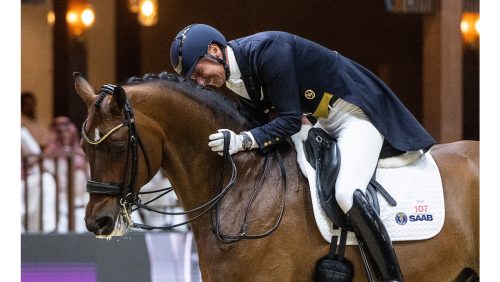
The Chronicle of the Horse is celebrating its 85th birthday in 2022. For eight weeks leading up to the publication of our 85th Anniversary Issue, we’re bringing you a decade-by-decade look at the history that has filled its pages since 1937.
In the 1990s, the Chronicle was there for the highlights, such as two Olympic Games and three World Equestrian Games, as well as the lows like the horse insurance killings involving Barney Ward, George Lindemann, Paul Valliere and several others. And because things in the horse world never truly change, familiar controversies like amateurs versus professionals, pony measurement, television coverage of equestrian sports and the helmet debate continued.
A popular horse care column appeared almost every week with advice on everything from building safe fences to getting rid of tapeworms. Industry experts like Cherry Hill and Dr. Eleanor Kellon, VMD, contributed. Frequent columns on sport horse breeding and dressage theory also dotted the pages.
Today the Internet has largely changed the way classified ads are published, but the Chronicle’s pages were filled with them in the 1990s. Eight to 10 pages of ads for horses, jobs, real estate, dogs and transportation guaranteed you’d find what you needed there.
Humor played a large part in the magazine, too. Articles by Cooky McClung would always get a chuckle, and cartoons by Custer Cassidy offered a fun view of the life of a horse owner.
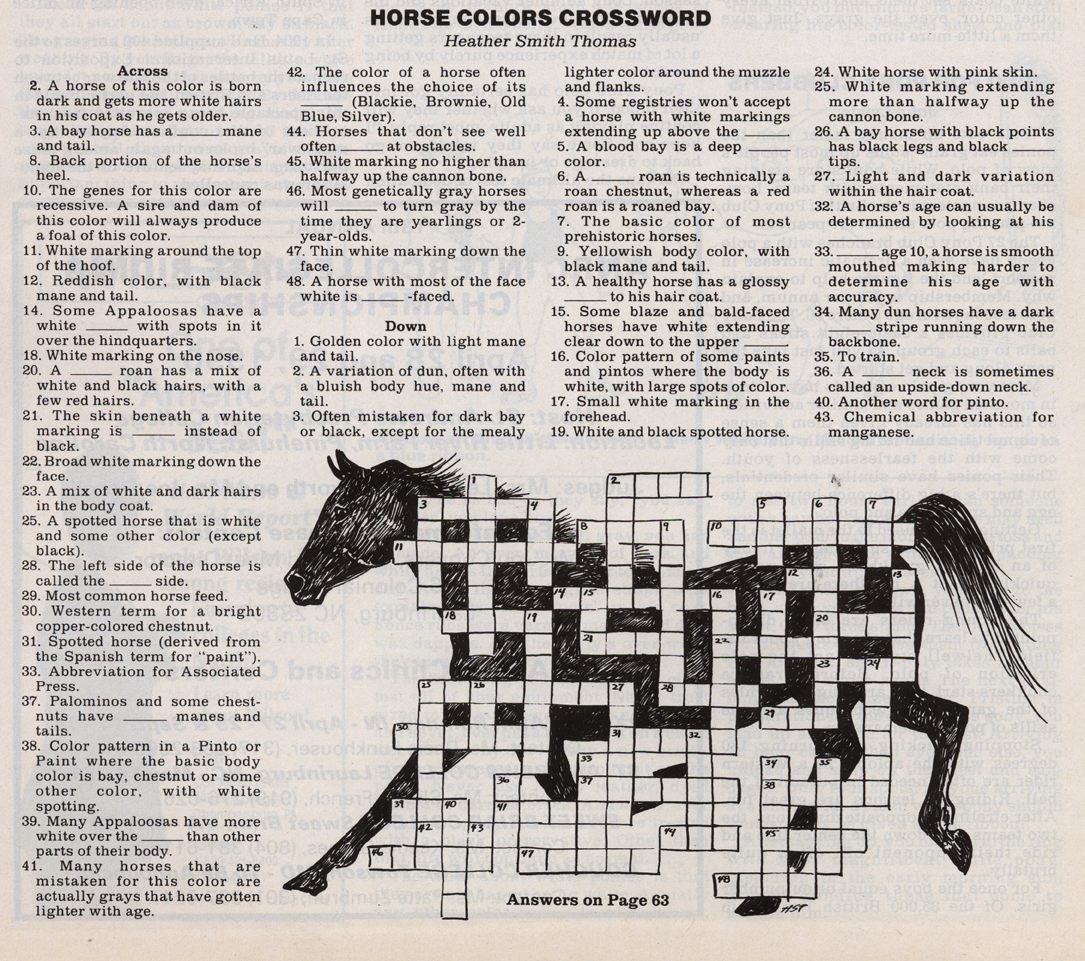
Crossword puzzles were common in the magazine in the 1990s.
Dawn Of A New Age
The first issue of the new decade covered several new changes to elite horse sports. Topics discussed at the Fédération Equestre Internationale meeting in Barcelona, Spain, included forming a committee to advise the FEI on footing (more and more advertisements for footing companies popped up in this decade as riders became insistent on good riding surfaces) and to create guidelines for organizing committees, as well as introducing a freestyle test at the European and world dressage championships.
By mid-1990, talk turned to the inaugural World Equestrian Games in Stockholm. In the Aug. 24, 1990, issue, Chronicle President Peter Winants wrote his impressions of the world championships in an editorial.
U.S. riders brought home three medals; Becky Hart and RO Grand Sultan earned individual gold in endurance, Bruce Davidson and Pirate Lion brought home individual bronze in eventing, and the vaulting team earned bronze.
In June 1991, Winants officially retired, and Robert L. Banner succeeded him.
Sound Familiar?
Starting in the late ’80s and continuing into 1990 and 1991, the American Horse Shows Association struggled with the decision to require ATSM-approved helmets. In a Jan. 4, 1991, editorial John Strassburger offered his opinion. Some riders complained that the helmets were too heavy, too expensive or not available everywhere.
ADVERTISEMENT
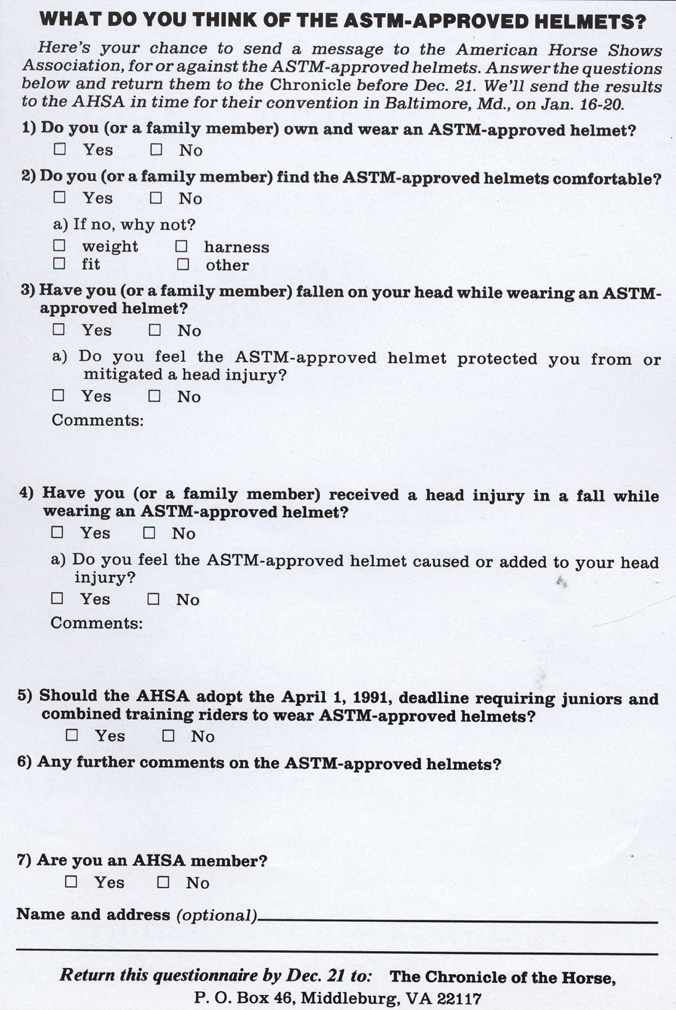
A Nov. 30, 1990, poll asked Chronicle readers to share their opinion on the helmet controversy.
In February 1990, the AHSA voted to delay for one year a new helmet rule requiring all juniors and all competitors in eventing to wear one. In 1991, they finally reached a compromise, recommending all riders wear ATSM/SEI-approved helmets and allowing juniors and eventing riders to continue to wear their now-obsolete Pony Club standard helmets.
The debate raged on throughout the ’90s, prompting numerous letters to the Chronicle from concerned readers.
Scandal In The Horse World
In February 1991, news broke that Tommy Burns and Harlow Arlie were arrested after undercover investigators from the Florida Department of Agriculture and Consumer Services watched them break a horse’s hind leg with a crowbar. Thus began a multi-year investigation into equine insurance fraud that the Chronicle covered in depth. Perhaps the most controversial of those convicted was Barney Ward, father of then rising star McLain Ward.
After Barney pleaded guilty to conspiracy to commit mail and wire fraud leading to the deaths of Charisma and three other horses, he served 33 months in federal prison and three years supervised release. He was suspended from AHSA shows for life. Barney wrote a Horsemen’s Forum in The Chronicle’s Nov. 19, 1999 issue in response to an editorial by John Strassburger. What followed was a slew of letters to the magazine, most expressing their outrage that continued well into the year 2000.
On With The Show
In 1991, the International Olympic Committee was on the verge of eliminating the team eventing competition from the Games, sparking suspicions that they were planning to eliminate all equestrian sports. The Chronicle encouraged readers to write to the IOC to try to change their minds. By the 1992 Barcelona Olympic Games, eventing was still included, but the U.S. team finished a disappointing 10th. They fared much better in the dressage team competition though, earning a team bronze medal, their first team medal in 16 years. In show jumping, Norman Dello Joio and Irish earned an individual bronze medal.
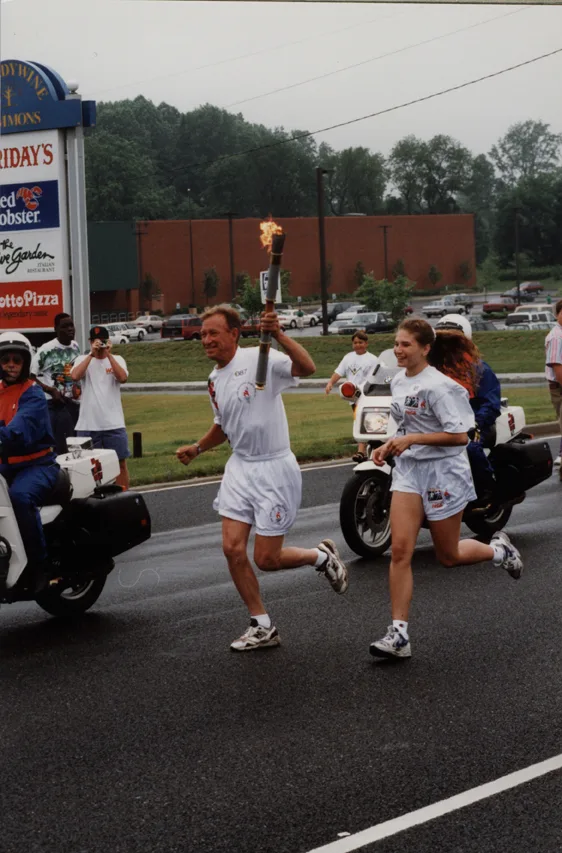
The 1996 Olympic Games in Atlanta were ground-breaking for horse sports, as testing for eventing horses provided valuable research into equine health at high temperatures, Karen and David O’Connor brought media attention with their participation, and the dressage freestyle made its debut.
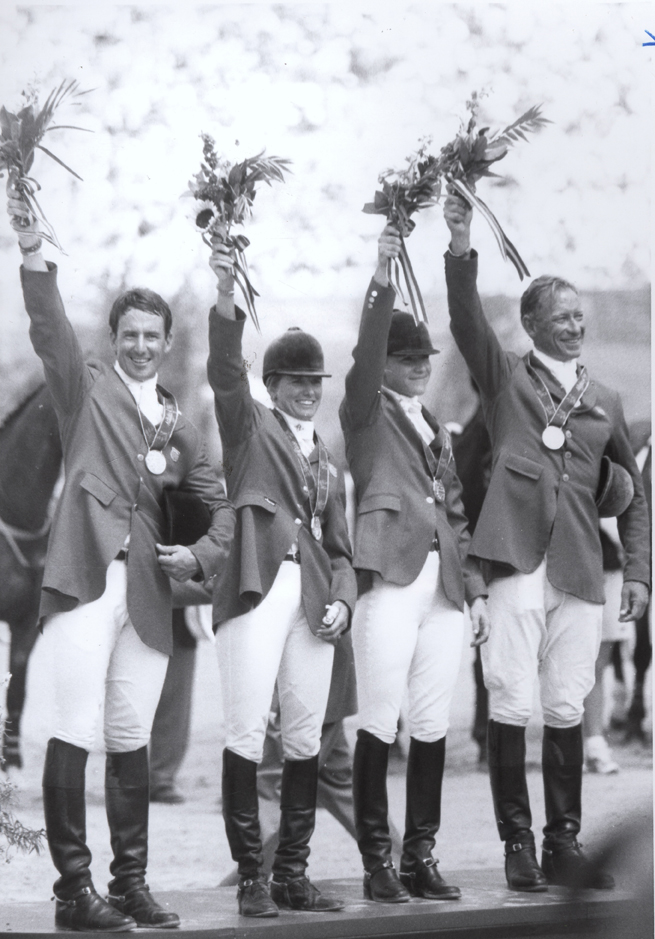
The U.S. eventing team won the silver medal at the 1996 Olympic Games in Atlanta. The riders were (from left) David O’Connor, Karen O’Connor, Jill Henneberg, Bruce Davidson. John Strassburger Photo
The Atlanta Games were the first where eventing was divided into a team and individual competition. Many riders were outspoken about the change. Australian rider Matt Ryan was not a fan, as he stated in the July 12, 1996, Olympic Preview Issue. “It was made by people who don’t understand the sport purely to prevent riders gaining two medals. With countries fielding their best in the teams, there is no incentive for team members to even start if their first two are out of the hunt. And it runs the eventual risk of diminishing the individual event.”
The U.S. team brought home a silver medal, and Kerry Millikin and Out And About won individual bronze. The dressage team earned bronze, and the show jumping team won silver.
The O’Connors became the first married couple on the U.S. Equestrian Team to compete together. During the Games they appeared on NBC’s coverage, as well as on CNN and in various non-horsey publications. Karen told the Chronicle, “I almost feel like it’s a responsibility, not an honor. It is an honor, but you feel like you have to take it on because exposure is what our sport is looking for.”
Once the three-day event was over, the couple couldn’t venture out into public without getting mobbed for autographs. “The Olympics give you a chance to explain the sport to people who otherwise would never come into contact with it, and I think the sport has been portrayed for exactly what it is this time,” she said.
ADVERTISEMENT
The dressage freestyle made its debut to much fanfare. The new scoring system in which the top 25 from the Grand Prix moved to the Grand Prix Special and the top 13 in the Special moved to the freestyle was mostly praised by riders. Gold medalist Isabell Werth of Germany said, “[This new format] is the best we can have because the winner must be good in all three. It is the best solution we can have.”
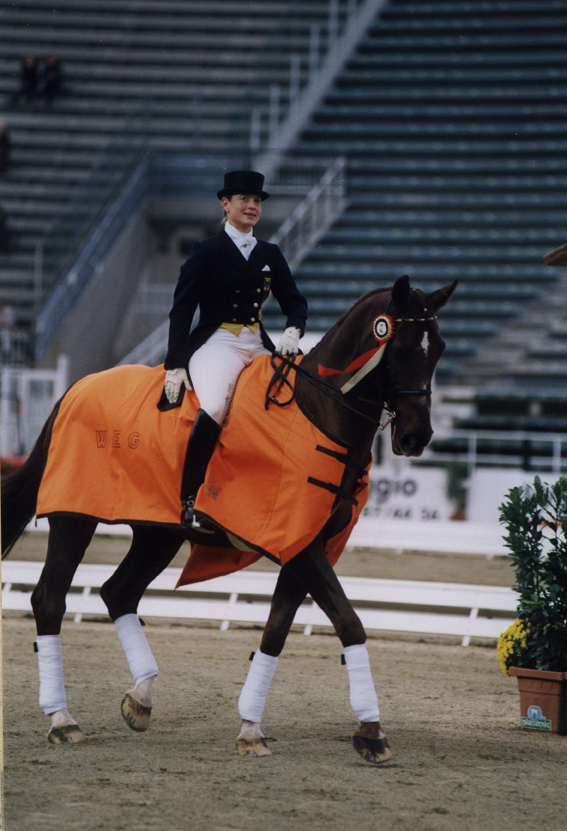
Isabell Werth and Gigolo won the individual gold at the 1998 World Equestrian Games. The German pair was nearly unbeatable during the 1990s. John Strassburger Photo
Individual silver medalist Anky van Grunsven of the Netherlands echoed that sentiment. “I think it helps our sport. [Dressage] can be really boring if you don’t know what you’re looking at, but watching the riding with the music is a beautiful thing. People look at it and love it.”
Return Of The National
In 1996, with the help of Sallie M. Wheeler, an heiress to the Anheuser-Busch fortune, the National Horse Show returned to Madison Square Garden in New York City after a seven-year stint across the river in New Jersey. While many were excited for the show to return to its former home of more than 100 years, they also criticized the logistics. Fewer horses would be allowed to compete, and fewer stalls would be available to exhibitors. But Wheeler had a vision for the future. “Everything will have to be fitted in, and some things will have to be removed and other things will have to be changed, but what I envision is a wonderful spectator event as well as a World Series for the horse people after a long season of horse shows,” she said in the Chronicle’s Nov. 17, 1995, issue.
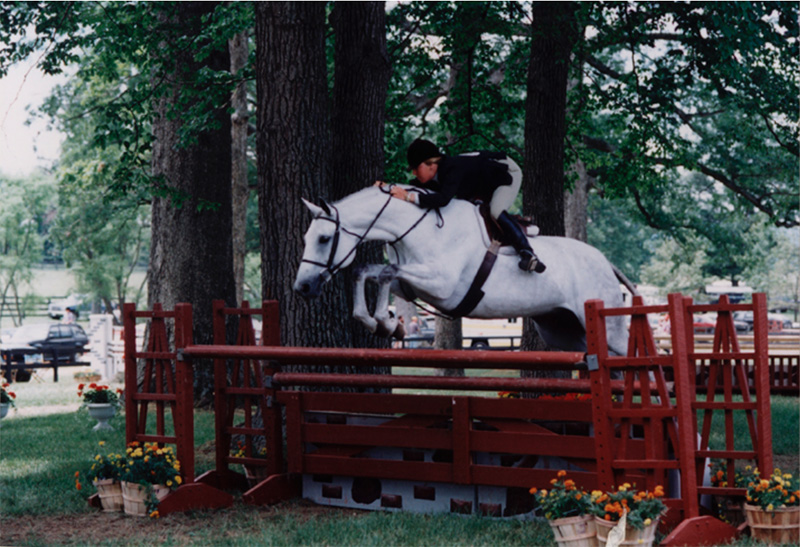
Rox Dene, The Chronicle of the Horse’s show hunter of the year in 1992 and 1994 and overall horse of the year in 1994, regularly swept the regular conformation and working divisions during her career. Here she’s shown with Elizabeth Solter at Upperville in 1994 on her way to taking the grand hunter championship. Teresa Ramsay Photo
Assistant editor Tricia Booker covered the 113th National Horse Show when it returned to Madison Square Garden and recalled fond memories in the Nov. 15, 1996, issue:
“The horse vans and trailers had to fight the incredible New York City traffic to dislodge their charges. And if you closed your eyes and just listened to the hooves’ hollow sounds on the sidewalks, and the rumbling hustle and bustle and honking in midtown Manhattan, you would remember the way it used to be. My most vivid memories of attending the National as a child were watching the horses walk amid the towering high-rise buildings to hike up that long, cavernous concrete ramp from ground level to center stage, three stories up. It had been my dream to walk my own horse up that ramp.”
An Upgrade To Rolex Kentucky
In 1998, the Rolex Kentucky Three-Day Event was upgraded to four-star (now five-star) status, becoming the first and only four-star in the United States. Nick Larkin of New Zealand won the event with Red. 1994 World Equestrian Games silver medalists Molokai and Dorothy Crowell finished in second place. The gelding was retired after the event, so it was an emotional day for Crowell. “My hope was to prove to everyone what a great horse he is one last time, and that happened,” she told the Chronicle in the May 8, 1998, issue.
Horses and riders at Rolex benefitted from the repeal of the 165-pound rule, which required them to carry lead weights on their saddle pads. (The FEI repealed the rule in late 1997.) Eventer Mimi Osborn, who had to carry up to 36 pounds of lead over the years at various three-days, told the Chronicle that she felt a major difference with all of her horses. “With the weight, at high speed, they get pushed past their distance—it takes an extra second or two to take off. Instead of run-jump, it’s run-grab-jump.”
Turn Of The Century
One of the final issues of the millennium was the Turn of the Century issue, published on Dec. 24, 1999. This 190-page issue was packed with Chronicle staff and industry leader’s picks of the 100 most influential horsemen and horses of the 20th century. The writers decided not to rank their choices, instead listing them in a chronologic order. Months of research went into the issue, which can now be considered a valuable reference to riders of all disciplines.
Read about all the decades of the Chronicle: the 1930s and 1940s | the 1950s | the 1960s | the 1970s | the 1980s | the 1990s | the 2000s
The Chronicle Through The Decades: 1990s
Lindsay Berreth / June 20, 2012 7:31 am