The Chronicle of the Horse is celebrating its 85th birthday in 2022. For the next eight weeks, leading up to the publication of our 85th Anniversary Issue, we’ll bring you a decade-by-decade look at the history that has filled its pages since 1937.
The 1950s brought big changes for horse sports and for the Chronicle, as it was still known throughout the ‘50s.
In the beginning of the decade, racing still dominated the Chronicle’s pages as it had during the 1930s and 1940s. The July 27, 1951, issue reported that Citation became the first “millionaire Thoroughbred” when he won the Hollywood Gold Cup by 4 lengths, and the magazine also closely followed the career of the great Native Dancer.

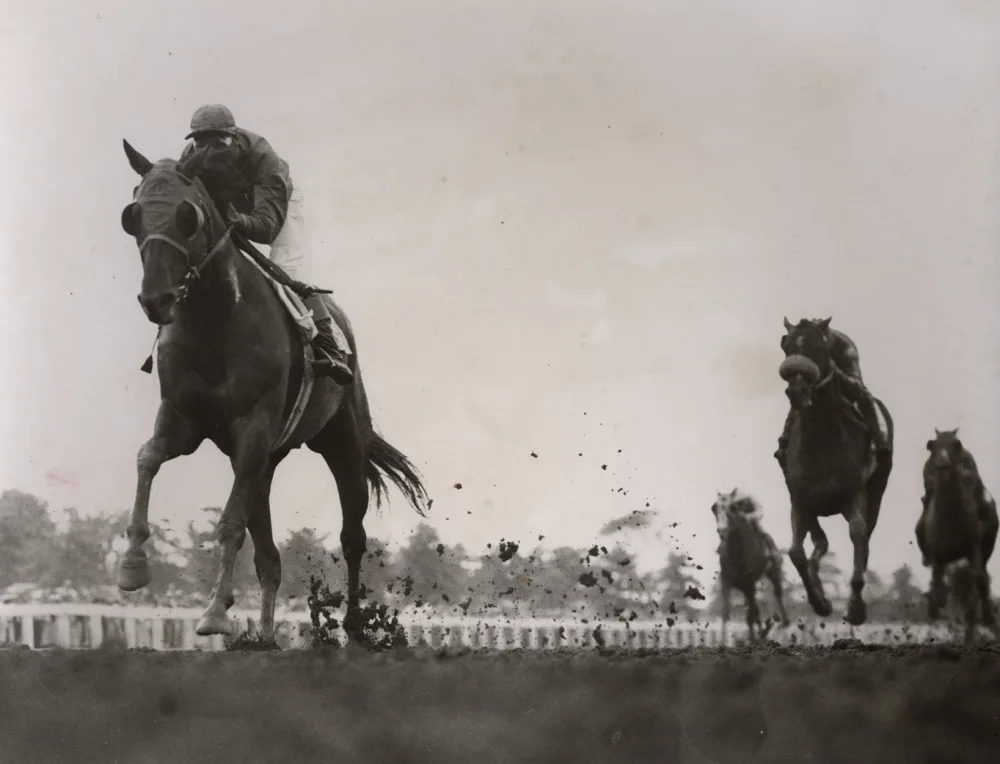
Nashua is pictured here winning the $100,000 Monmouth Handicap (N.J.) with Eddie Arcaro up in 1956. Turfotos Photo
Nashua came to prominence later in the 1950s, winning the Preakness Stakes (Maryland), Belmont Stakes (New York) and finishing second in the Kentucky Derby. He also won a match race against Swaps, the horse who defeated him in the Kentucky Derby. Then there was Bold Ruler, who won the Preakness in 1957, among other races, and would later go on to become the sire of Secretariat.
But the magazine was also starting to cover more and more horse shows. Alexander Mackay-Smith wrote in a Sept. 10, 1954 editorial, “These are boom times for horse shows. The hunter, jumper, junior and pony classes, which are the particular province of the Chronicle, were never fuller. Many new people are coming into the game and good horses and ponies are selling like hot cakes.”
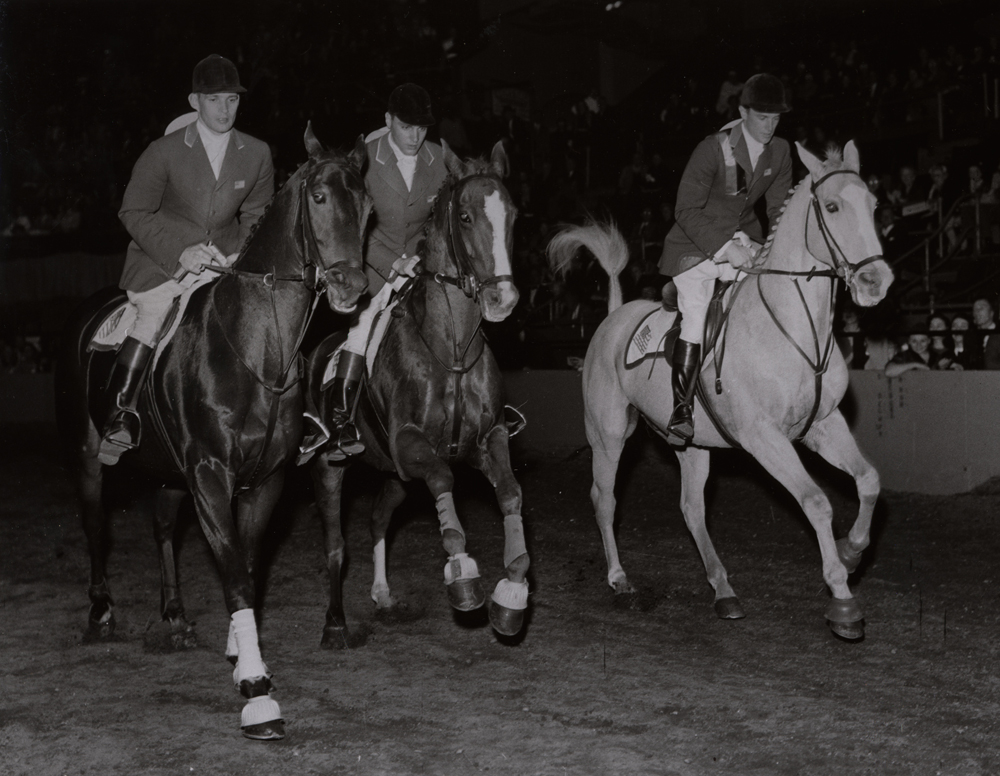
Members of the U.S. Equestrian Team (from left: Bill Steinkraus on First Boy, Frank Chapot on Pill Box and Hugh Wiley on Nautical) took a victory lap after winning an international jumping competition in 1957. Carl Klein Photo
The subject of the 1952 Olympic Games in Helsinki was a hotly discussed one leading up to those Games. The 1952 Olympics were the first where the United States sent a civilian team instead of members of the military, and there were questions about a proper selection process. The topic of women on the teams (dressage and show jumping only) was another issue.
The First Olympic Dressage Trials
The first Olympic Dressage Trials in this country were held Tuesday, April 1, 1952, at the Sleepy Hollow Country Club at Scarborough, New York. The dressage test was 15 minutes long and included piaffe, passage, extended and collecting walks, a figure-eight at “counter gallop,” “trot and gallop change of leads at every stride,” pirouettes and “zig-zag traversale.”
In the end, dressage competitor Marjorie Haines Gill became the first woman to ride on a U.S. Olympic Team. Gill placed 17th individually and sixth in the team competition with Flying Dutchman in Helsinki. The jumping team (William Steinkraus on Hollandia, Arthur McCashin on Miss Budweiser and John William Russell on Democrat) took home the bronze, and the eventing team (Jeb Wofford on Benny Grimes, Walter Staley Jr. on Craigwood Park and Charles Hough Jr. on Cassivellannus) also picked up a bronze.
Hot Topics
As the Chronicle expanded its reporting (covering 513 shows in 1955 compared to 250 in the “first few years after the war”), it also dealt with questions about what should be covered, finally coming to the conclusion that it was a magazine for the Thoroughbred and all Thoroughbred sports.
Other issues addressed in the editorials and letters to the editor during the 1950s included: poling as a training tool, why U.S. riders don’t place well when competing in Europe, whether we should begin using Fédération Equestre Internationale rules in U.S. competitions, retraining ex-racehorses for horse show work, true amateurs versus fake amateurs, barefoot horses versus shod horses, turning out versus leaving horses in stalls, how to get more depth on international teams, the judging at horse shows and proper turnout of riders and horses. Sound familiar?
Nancy G. Lee lamented the lack of appropriate dress at competitions in the Sept. 26, 1952 issue. “No one would think of going swimming in a baseball suit; neither would one go skiing in a lacrosse outfit. Why then can’t the outstanding sport of showing horses be treated with respect and courtesy by the riders?” she wrote.
From Posting Diagonals To Hunt Buttons
In the 1950s, the scope of topics covered in both the In The Country news items and the Letters To The Editor was vast and sometimes amusing.
• Sept. 11, 1953
I wonder if any of your readers could tell me which is the correct diagonal for posting when trotting in a circle.
When I was a child I was taught riding in England by my father who always insisted that one should post on the right diagonal on the right rein and vis viva, i.e. when trotting clockwise we should sit in the saddle when the right foreleg and left hindleg are on the ground and be out of the saddle when the left foreleg and right hindleg are on the ground. This theory, I note, is confirmed by Capt. V.S. Littauer on page 160 of “Be A Better Horseman.”
Since living in Canada, I’ve noticed that all the children are taught the reverse procedure, i.e. when trotting in a clockwise circle post on the left diagonal.
As I have a daughter who rides in equitation classes I would be most grateful to hear if there is a universally correct procedure or whether it varies in different countries.
Yours faithfully,
Pamela Edwards
ADVERTISEMENT
• Jan. 18, 1952
Dear Editor:
I am now serving in the Armed Forces in Europe. I would appreciate it very much if you would enter a subscription to The Chronicle for me. I really miss reading your paper since I came overseas.
I would also appreciate it very much if you could possibly start my subscription with the issue covering the Harrisburg show.
I travelled with the U.S. Equestrian Team last year and would like to keep posted on its activities as much as possible. As I can think of nothing better than The Chronicle to read, I hope you will send me the copies as soon as possible.
Thanking you in advance,
Pfc. Bernard R. Brenman
• In The Country, March 3, 1950
Button—Button
Buttons on hunting coats have a way of dropping off and disappearing. When they do they are hard to replace. Leonard Smith, Joint M.F.H. of Camargo with de Gray Vanderbilt, is off on a search for a good source for hunt buttons. He believes he can secure them at a cost of $1.00 each. Although not in the button business, he is willing to divulge his source of supply for those needing hunt buttons at a low price.
– In The Country, July 13, 1956
Cancelled Flight
Travis M. Kerr, owner of Bobby Brocato; Dr. Reed and Joe Hernandez recently returned to California from New York. They had reservations eastbound on the ill fated liner that crashed in the Grand Canyon, which they cancelled in favor of a night flight at the last moment.
• In The Country, Oct. 12, 1956
Did Carrots Get The Nod?
Before the first class at the Oregon State Fair, Harry Samuals owner of hunter Phar Rhona, appeared at the mare’s stall with both hands full. One hand held a luscious bunch of carrots, in the other a can of horse meat.
“Take your choice,” owner Samuals said.
The mare took a look and took her choice.
P.S. She won the Hunter Championship.
Some Things Change, Some Remain The Same
The Upperville Horse Show in Virginia celebrated its 100th anniversary on June 5, 1953, and the Chronicle was there reporting on the winners, just as it will be this year. Thoroughbreds were still the mounts of choice for almost every discipline then; they were even dominating in dressage at the time.
On Feb. 6, 1953, the magazine released a new format. The size of the page was reduced—from 56 to 31 1/2 column inches. The grade of the paper was improved, and all the illustrations were then printed from photo-engravings. Printing went from 20-24 pages up to 40-44 pages to make up for the smaller page size.
ADVERTISEMENT
“The members of The Chronicle staff, as well as our readers, will have to get used to the new size. Undoubtedly, there will be a few hitches to begin with. For any that may occur we ask your indulgence,” stated the announcement of the new format.
A new publisher and editor came along shortly after that, debuting in the Dec. 12, 1953, issue. George L. Ohrstrom took over as publisher, and Alexander Mackay-Smith became editor. The Chronicle also took that time of transition to lay out the mission statement again.
“More important than any of these things, however, is the fact that the Chronicle represents a way of life. It ties together the many thousands of people who love the American countryside and the horses and hounds which made it a doubly pleasant place in which to live. In an age of professionalism it represents the amateur and those who think of horses in terms of sport, rather than as a way of making a quick buck.”
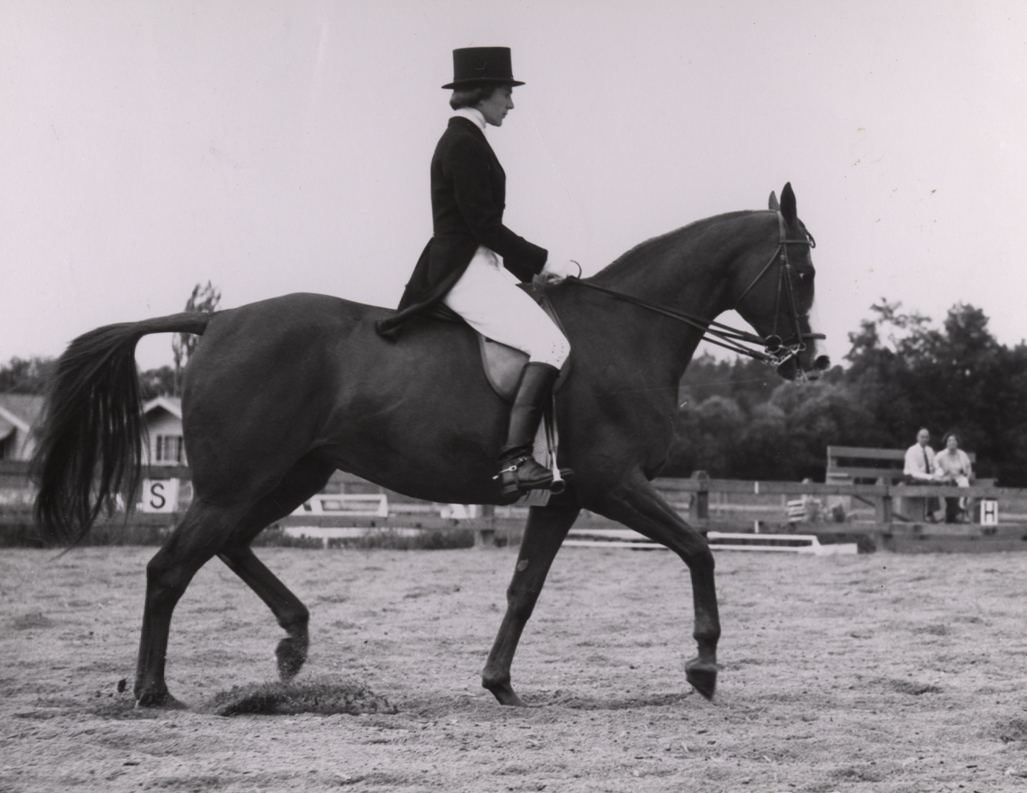
Inez Fischer-Credo rode the Thoroughbred mare Gordina, a former race horse, in a Prix St. Georges test at a 1959 dressage competition in Vancouver, British Columbia.
In the July 24, 1959, issue of the Chronicle it was announced that the publishers had acquired Horse magazine, though the full title of The Chronicle Of The Horse wouldn’t come about until 1961.
The 1952 Olympics inspired a discussion of the fledging discipline of dressage in the United States. In the June 26, 1953, issue Alexander Mackay-Smith wrote, “Now that the Olympics have deposited dressage on our doorstep what are we going to do with it? We should recognize at the outset that we are dealing with a great art, one that demands both from horse and rider the utmost in natural ability, hard work and execution. It offers one of the greatest, if not the greatest, heights of horsemanship attainable—if one has talent, devotion, a thoroughly qualified instructor and a great deal of time.”
An excerpt from Hermann Friedlaender’s report of California’s Santa Cruz Three-Day Test, which ran in the July 17, 1953, issue proved that riders have always loved galloping tracks for cross-country, and that they’ve always been afraid of ditches.
“It was interesting to note that each of the previous 3-Phase Events had a character all its own as far as type of terrain, obstacles and problems in the cross-country courses were concerned. Santa Cruz was still different from the others. It was fortunate in being able to afford lots of galloping and also presented the competitors with some fences entirely new to them. The outstanding one in this regard was No. 2—the Trakehner Graben—an 8-foot wide moderately deep ditch with a heavy, low fence in the middle—dubbed ‘the coffin’ by some. It proved to be nothing more than a mental hazard to the riders; to the horses as a whole it offered very little trouble.
“The main general weakness of our riders is in dressage, which weakness carries over to the other jumping phases of the event as well. For the most part the horses can jump, though many give the impression of having been pushed a little too fast and lack the style to go on to tougher, more formidable courses,” continued Friedlander.
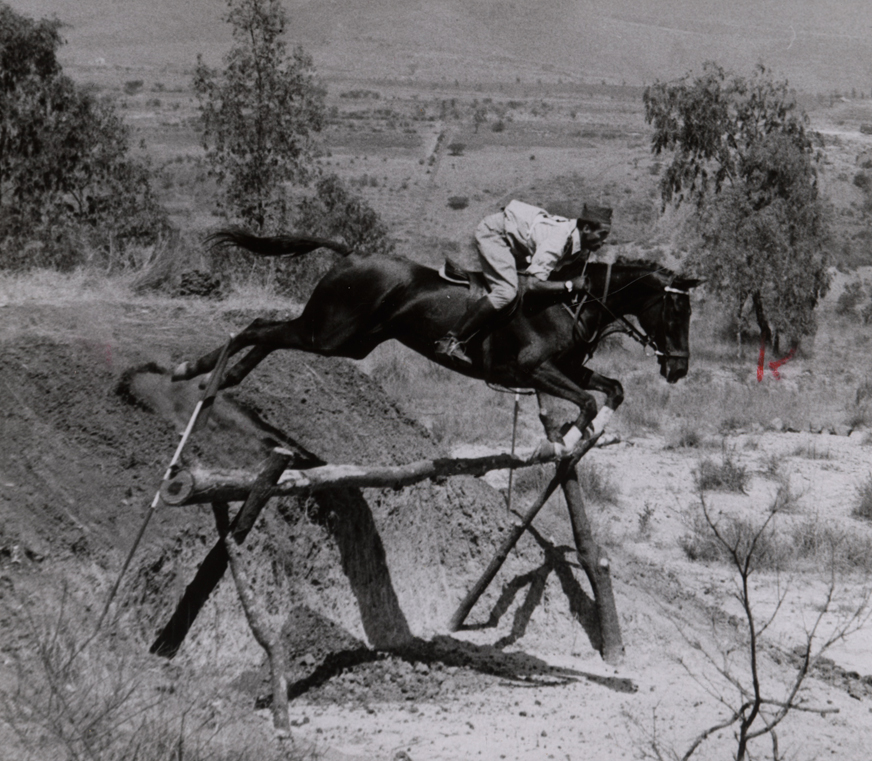
Lt. Carlos de la Serna of Argentina is pictured jumping over a 1955 cross-country obstacle on Zoldi. “Note the light contact with the rein,” stated the original caption. June Rice Fallaw Photo
Jeb Wofford rode at the selection trials for the 1955 Pan American Games and 1956 Olympics in 1954, even though he was still recovering from dysentery. A commentary by Alexander Mackay-Smith outlined the amazing events of the three days.
The Direction Of High Performance
While the 1956 Olympic Games were hosted by Australia, quarantine regulations meant the equestrian events were held in Stockholm instead. A report from the Three Day Event at the 1956 Olympics, written by Lt.-Col. C.E.G. Hope, stated that, “The Americans are young and their horses are good, but they seem unorganized and unschooled. If they could obtain the services of a good European dressage instructor and work hard under him, they could produce a reasonable team. But for every country the lesson of the Olympics is that inefficiency does not pay—and is unfair to the horse.”
The less-than optimal showing from the U.S. contingency in 1956 (teams and individuals finished out of the medals in all three sports) inspired much discussion about the future direction of the U.S. Equestrian Team.
An editorial in the Sept. 28, 1956 issue highlighted those issues, stating, “Although the meeting fully recognized the importance of good coaching, primary emphasis was placed on broadening the base on which our teams rest. In the long run, we cannot expect to win Olympic medals by developing a handful of horses and riders.”
As of 1957, the USET was based out of Greenwich, Conn., at Alvin Untermyer’s estate. “The rooms are small, not fancy but quite comfortable. Here the team members and the coach, Capt. de Nemethy live,” stated the article. In 1958, a 20-year-old George Morris was already riding for the USET, along with Bill Steinkraus, Hugh Wiley and Frank Chapot.
There was also an editorial about how the USET could best seek funding and earn favor from other nations, sending our riders out into the world as the “best ambassadors” in turbulent times. Horsemanship was even offered as a sort of way to fight the spread of Communism.
A report from the 1959 Pan American Games in Chicago revealed that dressage was still a work in progress for many countries.
“Only very few horses of the ten shown performed the Piaffe and Passage in an acceptable manner, if they performed them at all,” wrote Hermann Friedlaender in the Oct. 2, 1959 issue of the magazine.
Patricia Galvin from the U.S. won the individual gold with Rath Patrick.
“There was fairly general agreement after the ride-off that the performances of Rath Patrick under Patricia Galvin were the best. They were even and smooth and though devoid of any particular highlights the horse appeared in general to be at ease and showed a freshness that was pleasing,” wrote Friedlaender.
Read about all the decades of the Chronicle: the 1930s and 1940s | the 1950s | the 1960s | the 1970s | the 1980s | the 1990s | the 2000s
The Chronicle Through The Decades: 1950s
Lisa Slade / May 29, 2012 5:50 am